Tuesday, January 27, 2015
Multi-Genre Projects: Crumbled Creativity
While skimming through the provided list of multi-genre projects, I found the one titled 'Crumbled Creativity' to be the most interesting. I enjoyed how she incorporated her honest opinion with very blunt facts. She got her ideas to the reader very quickly by giving examples of what the ideal high school English student consists of using objects such as a syllabus, conversations, etc. I found it to be humorous just because the standard modern English student is piled with assignments based off of literature, but the assignments lack the opportunity to be creative on our own. English class should ideally help students to better their writing skills as a whole, which includes fishing for good ideas and being able to creatively put ideas together to form something interesting and worth reading. Instead, we are piled with readings and questions that only have one right answer. It is the sad truth, but if we spend all of our time focusing on the analytics of already-published pieces, what will be studied in English classes 20 years from now?

Monday, January 26, 2015
Reading Response 3: UN Millennium Goals
The United Nation Millennium Goal that stood out to me the most was to promote gender equality and empower women. I found this to be an interesting topic for many reasons, mainly because I couldn't agree any less with the fact that women need to stop men from holding a "higher" view in society. I recently read a book called Lean In, and it touched on many facts and issues we face today dealing with gender bias. Women nowadays are working their way up to the top with men, but we still face many controversial issues with gender.
"Women are gaining ground in the labour market, but in every developing region still tend to hold less secure jobs." Women in top positions in the workplace is something that we are seeing more and more of as time goes on, but it never really used to be common. If you are a woman and were aware of this (as I am) , it might just make you want to prove everyone wrong. There is no reason why a woman can't do anything that a man couldn't. Other things that women deal with are opportunity for education and less jobs outside of agriculture. Women are also more likely to be a victim of sexual violence.
To improve these issues, women and young girls all around the world are getting better education which will hopefully lead to more positive outcomes in the future. Maybe one day we will have a female president, but until then, we must continue to be aware that all women are just as equal to men and deserve the same opportunities, education, and freedoms as they do.
"Women are gaining ground in the labour market, but in every developing region still tend to hold less secure jobs." Women in top positions in the workplace is something that we are seeing more and more of as time goes on, but it never really used to be common. If you are a woman and were aware of this (as I am) , it might just make you want to prove everyone wrong. There is no reason why a woman can't do anything that a man couldn't. Other things that women deal with are opportunity for education and less jobs outside of agriculture. Women are also more likely to be a victim of sexual violence.
To improve these issues, women and young girls all around the world are getting better education which will hopefully lead to more positive outcomes in the future. Maybe one day we will have a female president, but until then, we must continue to be aware that all women are just as equal to men and deserve the same opportunities, education, and freedoms as they do.
Thursday, January 15, 2015
Start Something that Matters: Reading Response #2
1. http://startsomethingthatmatters.maker.good.is/projects/foodshift?position=19&sort=896
This article is about an idea that came from a girl named Dana. She created FoodShift in order to reduce food waste while giving people part-time employment. This will also help the green economy. Americans dispose 40% of all food while 50 million Americans don't have easy access to food. This article caught my eye due to the fact that this truth is a harsh and scary one that the world faces today, and yet it IS solvable as the article mentions.
2. http://startsomethingthatmatters.maker.good.is/projects/goodspread?position=29&sort=263
This article is about two men who started a Peanut Butter company called Good Spread. They set out in a Winnebago to deliver small packets of all natural peanut butter (contains milk and vitamins) in order to try to eradicate hunger and severe acute malnutrition. This article caught my eye because I love peanut butter, and it's for a wonderful cause.
3. http://startsomethingthatmatters.maker.good.is/projects/highergroundfarm?position=27&sort=291
This article is about two people who have came up with the idea of "Higher Ground Farming." This concept allows all natural farming to happen in cities, as they buy out rooftops throughout the city. This helps food supply while doing it the right way. If I do say so myself, it's a very clever and innovative idea as urban areas continue to populate.
All of these articles hit a soft spot with me. Hunger and food are serious problems in the world today, and it makes me extremely happy when people can come up with solutions that actually work. If more people were to realize this, we could all start something big.
If I didn't have to worry about money, I would worry about making myself happy along with others. I would focus on the small things in life and just simply being able to enjoy every moment. The kind of work I want to do is something that makes sense with organization, numbers, and good people. I'm looking into accounting of course, but I could make my future just that much better by being an accountant for a company with a good cause. If I had to choose a cause, I would definitely choose hunger. Lots of kids depend on school food on the week days just because their parents don't make enough to get by. Food is one of the most important things for our health as humans, so it's an easy difference that you can make.
This article is about an idea that came from a girl named Dana. She created FoodShift in order to reduce food waste while giving people part-time employment. This will also help the green economy. Americans dispose 40% of all food while 50 million Americans don't have easy access to food. This article caught my eye due to the fact that this truth is a harsh and scary one that the world faces today, and yet it IS solvable as the article mentions.
2. http://startsomethingthatmatters.maker.good.is/projects/goodspread?position=29&sort=263
This article is about two men who started a Peanut Butter company called Good Spread. They set out in a Winnebago to deliver small packets of all natural peanut butter (contains milk and vitamins) in order to try to eradicate hunger and severe acute malnutrition. This article caught my eye because I love peanut butter, and it's for a wonderful cause.
3. http://startsomethingthatmatters.maker.good.is/projects/highergroundfarm?position=27&sort=291
This article is about two people who have came up with the idea of "Higher Ground Farming." This concept allows all natural farming to happen in cities, as they buy out rooftops throughout the city. This helps food supply while doing it the right way. If I do say so myself, it's a very clever and innovative idea as urban areas continue to populate.
All of these articles hit a soft spot with me. Hunger and food are serious problems in the world today, and it makes me extremely happy when people can come up with solutions that actually work. If more people were to realize this, we could all start something big.
If I didn't have to worry about money, I would worry about making myself happy along with others. I would focus on the small things in life and just simply being able to enjoy every moment. The kind of work I want to do is something that makes sense with organization, numbers, and good people. I'm looking into accounting of course, but I could make my future just that much better by being an accountant for a company with a good cause. If I had to choose a cause, I would definitely choose hunger. Lots of kids depend on school food on the week days just because their parents don't make enough to get by. Food is one of the most important things for our health as humans, so it's an easy difference that you can make.
Monday, January 12, 2015
Article 1 Response
In 7 Grammar Rules You Should Really Pay Attention To, Ben Yagoda talks about the most common errors in writing today. These easy "oopsies" consist of subjunctives, parallelism, verb problems, pronoun problems, a 'dangling' conversation, semicolons, and words. When I was reading through the examples that were shown in the article, I was shocked to read this one:

This one sounded extra silly to me, but maybe that's because I don't use the word 'fish' often. In all reality, the word IS pretty hard to use correctly when it comes to subject-verb agreement. I found most of the grammar rules that were mentioned pretty easy to understand though, but I still don't fully understand some situations. The picture I used depicts my reaction to the quoted correction above. It sounded a little off to me, but I can keep this in mind to improve my grammar in the future. This article opened my eyes to critiquing my own writing.
"* The fish laid lay on the counter, fileted and ready to broil."
Tuesday, December 2, 2014
Pecha Kucha - Time-Based Art by Justin Hoover
Time-Based Art
By Justin HooverJustin Hoover has an interesting Pecha Kucha overall. He flowed very nicely from slide to slide and had lots to say about each image he shared. His idea of "time-based art" is uniquely explained with each picture to make it sound much cooler than it looks at the first glance.
To improve, Justin could have gotten to the point a little faster than he did, but it's easy to understand as he had a lot to share. His artwork was very modernized and unique. For example, he went into depth of a photo of a chess game played with ice chunks. The game can only be played within the amount of time that the ice remains frozen. Justin explains this quickly, but could easily get to the point in order to not lag as his presentation moves on.
The presentation was entertaining as a whole. It's an interesting topic to share his perspective on, and well put-together. Watching this Pecha Kucha makes me feel better about mine as I figure out what I want to share with the class. I feel like I will be able to successfully fill 10 slides with information on the old tradition of foot-binding in China.
Tuesday, November 11, 2014
Chinese Research: Foot-binding
There's a lot more behind the old tradition of foot-binding than a lot of people think. First off, foot-binding started off in the Song Dynasty (era of Chinese history beginning in 960 A.D.) and lasted up until the mid-1900's. It was a tradition that would involve young girls making their feet smaller than they should be. This tradition was viewed as a standard of beauty back then, just as girls wear make-up in modern American times. Taylor from Qingdao University shared her terrible views of foot-binding and stated that the tradition was finally abolished by the National Republic of China.
 Foot-binding is the process of making your feet into "3-inch lotus feet." It's a very brutal process that calls for extra maintenance. The feet can easily be infected, so nail clipping, frequent washing, massage, and the removal of dead skin was the norm. The process begins by soaking the feet of a young girl, usually between 2-5 years old, in a warm mixture of animal blood and herbs. A massage would follow the brew soak in order to relax the muscles in the foot so they can easily be rearranged. Toes are curled and pressed into the a sole until broken. The arches would eventually break, and warm cloth strips, which were soaked in the brew of blood and herbs, were wrapped to hold the toes against the sole of the foot. They were sewn in a way that would prevent the girls from taking the wraps off. Once sewn, the girl would be ordered to stand so the pressure would press them into the soles even more. See this article for more information on the process.
Foot-binding was mainly a symbol for wealth and luxury. The smaller feet you had, the more likely you were to get a great husband. This symbol eventually lost meaning, as lower classes began imitating the rich. The extremely poor were the only ones who didn't participate in the process, not because they didn't want to, but because of the lack of money and supplies. Though the tradition was outlawed in 1911, lotus shoes were still being manufactured until the 1900's as antiques. Due to complaints, all lotus shoes were removed from displays and shelves all over the world.
I chose this research topic because I found it super interesting how far women would go just to make themselves "beautiful," based on the standards of their culture. I heard of foot-binding in Asian Studies class during my junior year of high school. We didn't really go into depth unfortunately, which has motivated me to look more into this tradition. I personally believe that it was ethically wrong, but I am not one to judge their standards. It's understandable that they would view beauty in such a way, but I do not necessarily agree with the extreme precautions they practiced.
Works Cited:
Tan, Melissa. "Painful beauty how lotus feet are made." New Moon Girls May-June 2012: 22+. Student Resources in Context. Web. 11 Nov. 2014.
"Footwear of Early Asian Cultures." Fashion, Costume, and Culture: Clothing, Headwear, Body Decorations, and Footwear Through the Ages. Ed. Sara Pendergast, et al. 2nd ed. Vol. 2: Early Cultures Across the Globe. Detroit: UXL, 2013. 237-243. Student Resources in Context. Web. 11 Nov. 2014.
 Foot-binding is the process of making your feet into "3-inch lotus feet." It's a very brutal process that calls for extra maintenance. The feet can easily be infected, so nail clipping, frequent washing, massage, and the removal of dead skin was the norm. The process begins by soaking the feet of a young girl, usually between 2-5 years old, in a warm mixture of animal blood and herbs. A massage would follow the brew soak in order to relax the muscles in the foot so they can easily be rearranged. Toes are curled and pressed into the a sole until broken. The arches would eventually break, and warm cloth strips, which were soaked in the brew of blood and herbs, were wrapped to hold the toes against the sole of the foot. They were sewn in a way that would prevent the girls from taking the wraps off. Once sewn, the girl would be ordered to stand so the pressure would press them into the soles even more. See this article for more information on the process.
 Foot-binding was mainly a symbol for wealth and luxury. The smaller feet you had, the more likely you were to get a great husband. This symbol eventually lost meaning, as lower classes began imitating the rich. The extremely poor were the only ones who didn't participate in the process, not because they didn't want to, but because of the lack of money and supplies. Though the tradition was outlawed in 1911, lotus shoes were still being manufactured until the 1900's as antiques. Due to complaints, all lotus shoes were removed from displays and shelves all over the world.
I chose this research topic because I found it super interesting how far women would go just to make themselves "beautiful," based on the standards of their culture. I heard of foot-binding in Asian Studies class during my junior year of high school. We didn't really go into depth unfortunately, which has motivated me to look more into this tradition. I personally believe that it was ethically wrong, but I am not one to judge their standards. It's understandable that they would view beauty in such a way, but I do not necessarily agree with the extreme precautions they practiced.
Works Cited:
Tan, Melissa. "Painful beauty how lotus feet are made." New Moon Girls May-June 2012: 22+. Student Resources in Context. Web. 11 Nov. 2014.
"Footwear of Early Asian Cultures." Fashion, Costume, and Culture: Clothing, Headwear, Body Decorations, and Footwear Through the Ages. Ed. Sara Pendergast, et al. 2nd ed. Vol. 2: Early Cultures Across the Globe. Detroit: UXL, 2013. 237-243. Student Resources in Context. Web. 11 Nov. 2014.
Tuesday, October 28, 2014
Face to Face Response
Fear
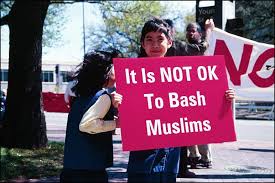
Anjum Mir does a great job of speaking about her fear in an unbiased manner. She expresses her fear for others' reactions to her and her child since they were Muslim. After 9/11, waiting a week to go in public with her child was necessary in lots of ways. She understood that she should not put her child in a position where he should be discriminated against at a young and innocent age. She was understanding to the natural reaction from Americans, which is a big part of overcoming her fear. Although our country should not be this way, it is. All Americans are just that, and to be discriminated against for being different, especially being allowed by the constitution, is wrong.
 Anger
Anger
Muslim-Americans have the right to be angry for many reasons. People from their country had attacked the U.S. in the name of Islam, which put out a bad reputation for many Muslims. Muslim-Americans these days are almost forced to validate themselves in a way to make them appear to be safe in the eyes of concerned Americans. It isn't fair to them since they had no part in what was going on. Although it's natural to wonder "what if," it just isn't right. Americans have a right to want to defend their homeland, but we should also open our eyes and recognize that just because someone comes from a certain place or heritage, doesn't mean that they have the same negative intentions as their ancestors.
Subscribe to:
Posts (Atom)